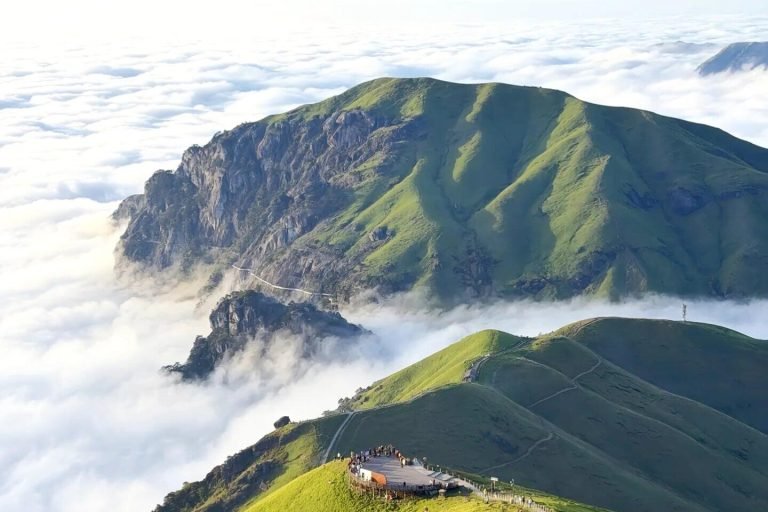
Tea tasting in Yunnan is not a leisure activity — it is a civilisational act. In the mist-wrapped mountains of China’s most biodiverse province, where ancient trees older than European cathedrals still push new leaves into the subtropical air each spring, tea is not a product. It is a philosophy, a ceremony, a language spoken between grower and guest across a small clay cup. For luxury travellers who have tasted everything, Yunnan offers something genuinely rare: an experience that cannot be purchased on a shelf or replicated in a hotel lounge anywhere else on earth.
This is the origin point of the world’s tea culture. And in 2026, more discerning travellers than ever are choosing to come here privately — to go deep, go slow, and go far beyond the tourist surface.
Why Yunnan Is the World’s Most Important Tea Destination
The case for Yunnan’s pre-eminence in global tea culture begins with geology and climate. The province sits at the intersection of the subtropical south and the Himalayan north — a collision of altitude, humidity, ancient red soils, and biodiversity that creates growing conditions found nowhere else. The result is a staggering variety of teas, from the complex, aged pu-erh pressed into stone-wrapped cakes in Xishuangbanna to the brilliant copper-red Dianhong black teas of Lincang, whose aroma carries notes of honey, orchid, and warm stone.
Yunnan is also, in the truest sense, the genetic birthplace of Camellia sinensis — the tea plant. The ancient wild tea forests of Jingmai Mountain, now a UNESCO World Heritage Site, contain trees that have been cultivated for over a thousand years. To stand beneath one of these canopy giants, its gnarled trunk furred with lichen, its top leaves translucent in the morning light — and then to taste a cup brewed from those very leaves — is to experience time differently.
No tea sommelier course, no artisan tea shop in London or New York, no matter how thoughtfully curated, can offer that.

The Six Pinnacle Tea Tasting Experiences in Yunnan
1. A Private Gongfu Cha Session with a Pu-erh Master in Kunming
Kunming — the Spring City, sitting at 2,100 metres above sea level — is the intellectual capital of China’s tea world. It is here that the most serious collectors, scholars, and blenders converge, and where the finest aged pu-erh cakes change hands in transactions that rival wine auction rooms for seriousness and price.
A bespoke Xiora itinerary can arrange a private Gongfu Cha ceremony led by a recognised pu-erh master: a deeply choreographed practice in which water temperature, steeping time, clay teapot seasoning, and the sequence of infusions are calibrated with the precision of a perfumer. You will taste the same leaf at its third, fifth, and ninth infusion — each cup a different conversation. The master will speak; your guide will translate not just the words but the context, the decades of sensory memory behind each statement.
This is not a tea ceremony for tourists. It is an invitation into a private world of expertise that most visitors to China never know exists.
2. Dawn in the Ancient Tea Gardens of Jingmai Mountain, Xishuangbanna
If you rise before the sun in Jingmai, you will encounter one of the most achingly beautiful agricultural landscapes on earth. The terraced tea gardens — some plots tended by the same Blang and Dai minority families for forty generations — emerge from the night mist in long, curved rows, the leaves silver with dew. The silence is absolute, interrupted only by the distant call of a bird you cannot name.
A private guide with deep roots in the region — and Xiora insists on this calibre — can take you directly to a family compound where the morning’s first flush is being processed by hand: withered on bamboo racks, wok-fired to halt oxidation, then rolled with palms and fingers into tight spirals that release their fragrance into the cool air. You will taste the fresh leaf, still warm from the wok, before it has even been dried. It is grassy, vegetal, startlingly alive — nothing like the compressed pu-erh cakes sold in shops. It tastes like the mountain itself.
“To taste a fresh leaf still warm from the wok, in a Jingmai mountain courtyard at dawn, is to understand why tea became a civilisation — not merely a drink.”
3. Tracing the Ancient Tea Horse Road from Dali to Shaxi
For over a thousand years, caravans of mules and horses carried compressed pu-erh tea from Yunnan’s southern mountains northward through Dali, across the Cang Mountain range, and on toward Tibet — where tea was traded for warhorses that the lowland Chinese could not breed. The route that survives, known as the Ancient Tea Horse Road, or Chamadao, is one of the great trade arteries of pre-modern Asia.
A private Xiora itinerary can trace a section of this road from the Bai cultural heartland of Dali — its whitewashed, blue-gabled villages reflected in the still expanse of Erhai Lake — through to Shaxi, an almost perfectly preserved caravan town whose Friday market has continued uninterrupted for centuries. En route, tea tastings at historic caravanserai stops reveal how the compressed cake tea would have been broken and brewed over campfires at altitude: rough, smoky, extraordinary. Your guide will recount the merchant histories of specific family names still visible carved above doorways in Shaxi’s cobblestone squares.
4. A Twilight Tasting on the Erhai Lakeshore, Dali
As the Cang Mountains turn from ochre to violet above the western shore of Erhai Lake, a small wooden pavilion on the water’s edge becomes one of the most romantic places in all of China to drink tea. The Bai people of Dali have their own tea ceremony — the Three-Course Tea, or Sandao Cha — which moves philosophically through bitter, sweet, and lingering tastes, a metaphor for a life well-lived.
Xiora can arrange a private Sandao Cha ceremony at dusk, presided over by a Bai elder who has performed this ritual at family weddings, festivals, and seasonal ceremonies for decades. The first cup — bitter, brewed dark and strong — arrives with no apology. The second — sweetened with rock sugar and dried tangerine peel — is a relief. The third — a thin, warm broth of rice, walnuts, and honey — is a quiet, reflective ending. There is wisdom in the sequence that no lecture can convey.
5. Inside the Tea Factories and Pressing Rooms of Menghai
Menghai county, deep in the tropical south of Yunnan, is the industrial and artisanal heart of pu-erh production. Here, the most revered tea factories in China — some with histories stretching back to the Republican era — press, age, and warehouse cakes that collectors in Hong Kong, Taipei, and Tokyo acquire like blue-chip investments.
A private behind-the-scenes access visit — possible only through relationships that take years to build — takes you into the pressing rooms, the damp-aged storage caves where temperature and humidity are managed with the seriousness of a Burgundy cellar, and into the tasting rooms where blenders assess single-mountain maocha with closed eyes and extraordinary concentration. This is craft at an industrial scale, but it retains the sensory intelligence of a deeply human tradition. You will leave with a pressed cake bearing the stamp of a master blender who has just shaken your hand.
6. Butter Tea and Ceremony at Songzanlin Monastery, Shangri-La
Not all tea in Yunnan is delicate. In the high-altitude Tibetan plateau town of Shangri-La, at 3,200 metres above sea level, tea takes on a different, more elemental character. The Songzanlin Monastery — Yunnan’s largest Tibetan Buddhist complex, home to more than 700 monks — brews the traditional yak butter tea: a churned mixture of strong dark tea, salted yak butter, and milk that is simultaneously nourishing, warming, and unlike anything in the Western sensory vocabulary.
A Xiora private visit can include a quiet audience in the monks’ quarters, where butter tea is offered in deep celadon bowls as an act of hospitality rather than tourism. The incense smoke from the adjacent temple hall drifts through the courtyard. The mountains are visible over the golden rooftops. Drinking tea here, in this context, feels less like a beverage experience and more like a form of silent conversation with a very old world.

Tea Tasting in Yunnan: Choosing the Right Season
Spring — specifically the weeks bracketing the Qingming festival in early April — produces the year’s most coveted first-flush teas. The new buds, called mingqian (pre-Qingming) leaves, are harvested before the rains arrive, resulting in a delicacy and aromatic complexity that commands extraordinary premiums. If your schedule permits, aligning a Yunnan tea itinerary with this narrow window elevates the entire experience.
Autumn — October through November — offers the second harvest: slightly more robust, less precious, but extraordinarily expressive, with the harvest festivals of the Hani and Blang minorities adding a cultural layer to the agricultural calendar. Winter, as some specialist operators note, brings a quieter Yunnan entirely — the tea mountains peaceful, the air crystalline, the tea houses uncrowded and unhurried.
Summer, by contrast, is best avoided for tea-focused travel: the monsoon rains flatten the subtleties of the mountain landscape and dilute the tasting experience. Your private Xiora specialist will design your itinerary with the tea calendar — and your personal travel priorities — at its centre. Explore Xiora’s bespoke China tour packages to begin the conversation.
“The most coveted first-flush leaves are picked in a window of days, not weeks — aligning your journey with that moment transforms a fine trip into an unrepeatable one.”
What Makes a Luxury Tea Experience in Yunnan Genuinely Different
The difference between a standard tea tour and a luxury private tea experience in Yunnan is not primarily a question of accommodation — though the options are extraordinary, from the Alila Yangshuo’s karst-carved suites to the intimate Laomadian Lodge in Shaxi’s 150-year-old Bai compound. The real differential is access and depth.
Mass-market tours visit tea factories with gift shops. A Xiora private itinerary arranges breakfast with the family that owns the garden. Mass-market tours provide a translated sign outside a UNESCO site. A Xiora guide delivers a postgraduate-level commentary on the agricultural history of the Blang people, the economics of aged pu-erh, and the specific terroir variables that make a Laobanzhang-mountain cake worth three hundred dollars per hundred grams.
This is what no-shopping, no-commission, private specialist travel delivers: the undivided attention of an expert who has spent years building relationships in these villages, and whose entire professional focus — for every hour of every day of your journey — is on giving you the deepest possible engagement with one of the world’s great living cultures.
Travel Without the Friction
At Xiora Travel, our expert bilingual guides handle every logistical detail, ensuring a seamless, 100% no-shopping luxury experience. Your time belongs to the journey.
Explore Private Journeys ↗Practical Notes for the Discerning Yunnan Tea Traveller
Yunnan is a large province — larger than Germany — and its finest tea experiences are distributed across dramatically varied terrain. The tropical tea gardens of Xishuangbanna sit at roughly 600 metres above sea level; Shangri-La’s Tibetan plateau rises to over 3,200 metres. A well-designed itinerary accounts for acclimatisation, travel pacing, and the physical demands of mountain roads, particularly in the more remote areas of Lincang and the Pu-erh prefecture.
Private car travel is essential: the comfort, flexibility, and safety that a dedicated vehicle and driver provide across Yunnan’s mountain roads is not a luxury preference but a practical necessity. High-speed rail connects Kunming to several key hubs, and private domestic flights shorten the longer legs of a multi-region itinerary elegantly. Your Xiora specialist will design the logistics architecture of your journey to be invisible — so that what you experience is not travel, but arrival, again and again, in extraordinary places.
Frequently Asked Questions
What is the best type of tea to focus on for a first luxury tea experience in Yunnan?
For first-time luxury tea travellers in Yunnan, aged pu-erh tea offers the most intellectually and sensorially complex entry point. Unlike green teas, which reward freshness and immediacy, a well-stored aged pu-erh cake rewards patience — the same tea tasted across multiple infusions reveals layers of earthiness, camphor, dried fruit, and forest floor that evolve dramatically. Dianhong black tea from Lincang is an equally outstanding alternative for travellers more familiar with the Western tea canon, offering extraordinary complexity without the steep learning curve of pu-erh connoisseurship.
Is it possible to purchase exceptional teas directly from producers during a private Yunnan tour?
Yes — and this is one of the most compelling reasons to travel with a specialist guide who has genuine producer relationships. Purchasing directly from a Jingmai mountain family, or acquiring a pressed cake directly from a Menghai factory tasting room, provides not only access to quality that never reaches retail channels but also the provenance documentation and personal context that elevate a tea purchase into a genuine collector’s acquisition. Xiora guides facilitate introductions, handle all communication, and ensure that transactions are transparent and fairly priced — with zero commission incentive.
How does tea tasting in Yunnan fit within a broader luxury China itinerary?
Yunnan pairs exceptionally well with a broader southwestern China itinerary. A twelve to eighteen-day private journey might begin in Chengdu — for the Giant Pandas, Sichuan cuisine, and Leshan’s cliff Buddhas — before moving south into Yunnan for five to seven days of dedicated tea and culture immersion, ending in Guilin for the karst river landscapes. Alternatively, a Yunnan-only itinerary of ten to fourteen days, moving from Kunming south to Xishuangbanna and then north to Dali, Lijiang, and Shangri-La, provides sufficient depth for a truly meaningful tea-focused experience without sacrificing comfort or pace.