The journey from Singapore to Zhangjiajie takes, in 2026, approximately 4 hours and 55 minutes on the Loong Air direct service departing Singapore Changi Airport on Tuesday, Thursday, or Saturday mornings — a flight duration roughly equivalent to travelling from Singapore to the Maldives, but depositing you not on a beach at sea level but at the edge of a UNESCO World Heritage mountain wilderness where 3,103 individual quartz sandstone pillars rise between 200 and 400 metres from a forested valley floor, draped in mist that renders them, on certain April mornings, indistinguishable from the floating Hallelujah Mountains of Avatar. No visa is required: Singapore passport holders have enjoyed 30-day visa-free entry to mainland China since the bilateral agreement signed in November 2023. There is no jet lag: Singapore and Zhangjiajie share the same time zone, UTC+8, which means a 10:00 departure from Changi Terminal 1 delivers your party to Zhangjiajie Hehua International Airport (IATA: DYG) at approximately 15:00 local time — early enough to reach the hotel, have dinner at a Tujia restaurant, and be in a private vehicle heading for the Bailong Elevator base station at 06:30 the following morning. What this combination of logistics — direct flight, visa exemption, identical time zone — means in practice is that Zhangjiajie is closer, in terms of actual travel friction, to Singapore than almost any international wilderness destination of comparable magnificence on earth. The question is not whether to go. It is whether to go with the right guide.
✨ At a Glance
- The Core Reality in 2026: Singapore to Zhangjiajie is now a direct flight of under 5 hours (Loong Air, 3×/week, SIN→DYG), requires no visa for Singapore passport holders (30-day visa-free entry to mainland China), generates zero jet lag (both cities are UTC+8), and delivers travelers to one of the most visually extraordinary UNESCO World Heritage landscapes on earth before dinner on Day 1.
- Crucial Advice: The Loong Air direct service (Tue/Thu/Sat departures) operates with limited frequency and sells out 4–8 weeks ahead during the April–October peak season; Singapore travelers booking a private Zhangjiajie itinerary should confirm their preferred flight dates before finalising any other element of the trip, as the indirect routing via Changsha (7–9 hours total, daily options with China Southern and Sichuan Airlines) is the reliable fallback but adds a full travel day to the itinerary.
- The Xiora Solution: Xiora Travel’s Singapore-based clients receive a complete Singapore-departure private itinerary — from Changi pickup coordination and flight booking advisory to Zhangjiajie private vehicle, specialist crowd-routing guide, and Pullman Zhangjiajie accommodation — with zero shopping stops and a 24/7 guide who tracks the weather forecast for the Avatar mist window the night before your Yuanjiajie visit.
The Singapore Advantage: Why No City in the World Is Better Positioned for Zhangjiajie
Singapore sits at a singular convergence of logistical advantages for China travel that most European and American travelers do not have and most Chinese domestic travelers do not need. The 30-day visa-free arrangement between Singapore and mainland China — confirmed and operational through 2026 — eliminates the single most significant administrative friction in China travel for citizens of the United States, the United Kingdom, and Australia. The shared UTC+8 time zone eliminates jet lag entirely: your body arrives in Zhangjiajie at the same hour its internal clock believes it is, which means the 06:00 alarm for the Bailong Elevator first ascent on Day 2 is not a feat of willpower against a disrupted circadian rhythm but simply an early morning, of the kind that the Singapore population manages with practised ease on weekdays. The Changi Airport departure experience — one of the most efficient international airport processes in the world — deposits you at the gate with the unhurried composure that the journey to Zhangjiajie, and the landscape that awaits there, deserves.
There is also a cultural dimension to the Singapore-to-Zhangjiajie journey that deserves acknowledgment. Singapore’s population is approximately 74% ethnic Chinese, with significant communities of Hokkien, Teochew, Cantonese, and Mandarin speakers whose family histories in many cases trace a line back to the provinces of southern and central China — Fujian, Guangdong, Hunan — that the British colonial port city drew its labour from in the 19th and early 20th centuries. Hunan Province, where Zhangjiajie is located, was not a primary source of Singapore’s Chinese diaspora, but the journey from Singapore to Zhangjiajie carries for many Singapore Chinese travelers a quality of reconnection with a mainland cultural heritage that the Lion City’s cosmopolitan efficiency has kept at a certain productive distance. The Tujia people of western Hunan — the dominant ethnic minority in the Zhangjiajie region, whose traditional music, cuisine, and architectural heritage your Xiora guide will introduce as an integral element of the itinerary — are a living reminder that China’s cultural diversity extends well beyond the Han majority experience, and that the mountains of western Hunan hold a civilisation as distinct and as old as anything Singapore’s Chinatown has preserved.
Singapore to Zhangjiajie: Flight Options, Timing, and What Your Guide Advises
Three distinct routing options connect Singapore Changi Airport (SIN) to Zhangjiajie Hehua International Airport (DYG, also known as Dayong Airport) in 2026, each with different trade-offs in time, flexibility, and comfort:
Option 1: Loong Air Direct (SIN → DYG) — Fastest, Limited Schedule
The newly launched Loong Air direct service — inaugurated in late 2025 — is the most efficient option for Singapore travelers whose schedule aligns with the Tuesday, Thursday, or Saturday departure days. Flight time is 4 hours 55 minutes; fares from S$381 one-way (S$578 round-trip at best available in 2026). The limitations are meaningful: the route operates on only three days per week, sells out significantly in advance during the April–October peak season, and is operated by a Chinese budget carrier whose business class product and lounge access at Changi do not match the standard of Singapore’s legacy carriers. For Xiora clients, the recommendation is to book the direct flight as far in advance as the itinerary permits and treat the flexibility of indirect routing as the alternative rather than the first choice.
Option 2: Singapore → Changsha → Zhangjiajie (Most Flexible)
The Singapore Changi to Changsha Huanghua International Airport (CSX) route is served daily by China Southern Airlines, Sichuan Airlines, and Juneyao Air, with flight times of 4–5 hours and more comfortable cabin products for business class travelers. From Changsha, the high-speed rail connection to Zhangjiajie West station takes 2–3 hours on the dedicated Changsha–Zhangjiajie line, arriving at a station 30 minutes by private vehicle from the Wulingyuan park entrance. Total door-to-door time: 7–9 hours — a longer journey than the direct flight but one that adds Changsha as a cultural waypoint (see Changsha section below) and provides daily departure options that the Loong Air schedule cannot match. For Xiora clients combining Zhangjiajie with broader Hunan itinerary elements, this is the standard recommended routing.
Option 3: Hub Routing via Shanghai, Guangzhou, or Beijing
For Singapore travelers who wish to combine Zhangjiajie with other Chinese cities — Beijing and Xi’an for the imperial circuit, Chengdu for Sichuan food and panda culture, Guilin for the Li River karst landscape that provides a productive geological contrast with the Wulingyuan sandstone pillars — hub routing through a major Chinese city adds 2–4 hours of transit time but converts a single-destination trip into a multi-city itinerary that the private vehicle and guide system connects seamlessly. A Xiora consultant will design the routing logic for any Singapore-departure multi-city China itinerary based on the traveler’s specific combination of destinations and available travel days.

The 6-Day Tailor-Made Itinerary: Singapore to the Peaks and Back
The following itinerary is designed for Singapore travelers departing on a Tuesday morning Loong Air direct service and returning the following Sunday via Changsha connection — a structure that maximises five full days in the Zhangjiajie region while including a Changsha cultural evening on the return. As with every Xiora private itinerary, this is a starting architecture rather than a fixed schedule: the guide adjusts daily timing around weather conditions, crowd patterns, and the individual party’s energy and curiosity.
Day 1 (Tuesday) — Departure from Changi, Arrival at the Foot of the Pillars
Loong Air departs Singapore Changi Terminal 1 at approximately 10:00 on Tuesday mornings, landing at Zhangjiajie Hehua International Airport at approximately 15:00 local time — the same clock hour, zero jet lag, the afternoon light of western Hunan already warm and slanted by the time the aircraft descends over the forested ridges of the Wulingyuan valley. A Xiora private vehicle meets your party at arrivals and transfers directly to the hotel in Wulingyuan District, 15 minutes from the national park’s main entrance. The first evening is deliberately unscheduled: a private vehicle to the Wulingyuan village evening market for the guide’s introduction to Tujia street food — shayeba (fermented glutinous rice cake), wild-foraged mushroom skewers, and the bracken-fern stir-fry that is Hunan’s most underappreciated vegetable — followed by dinner at the restaurant the guide’s family has been eating at since before the park opened to foreign tourists, and an early night in preparation for a 06:00 alarm.
Day 2 (Wednesday) — Tianmen Mountain: Heaven’s Gate at Cloud Level
Tianmen Mountain (天门山) is kept deliberately separate from the national forest park in the Xiora itinerary — it requires a dedicated half-to-full day and offers a qualitatively different experience from the pillar formations of Wulingyuan. The Tianmen Mountain cable car — at 7.5 kilometres the longest aerial tramway in China at time of construction — ascends from Zhangjiajie city centre through 10 separate cloud layers before emerging above the tree line at the summit plateau. Tianmen Cave (天门洞) — a natural arch 131 metres high and 57 metres wide, formed through limestone dissolution at 1,264 metres of altitude — is reached either via the 999-step cliff staircase or by the secondary cable car from the cave platform; your guide will assess the day’s crowd patterns and your party’s preference for altitude and gradient. The summit glass-floored walkway extends from the cliff face on steel brackets at a height that offers an unobstructed view straight down approximately 1,400 metres to the valley floor — a perspective on vertical scale that establishes, before the pillar formations of Wulingyuan begin, the spatial grammar of what western Hunan’s mountains are doing.
Day 3 (Thursday) — Yuanjiajie: The Morning the Mist Performs
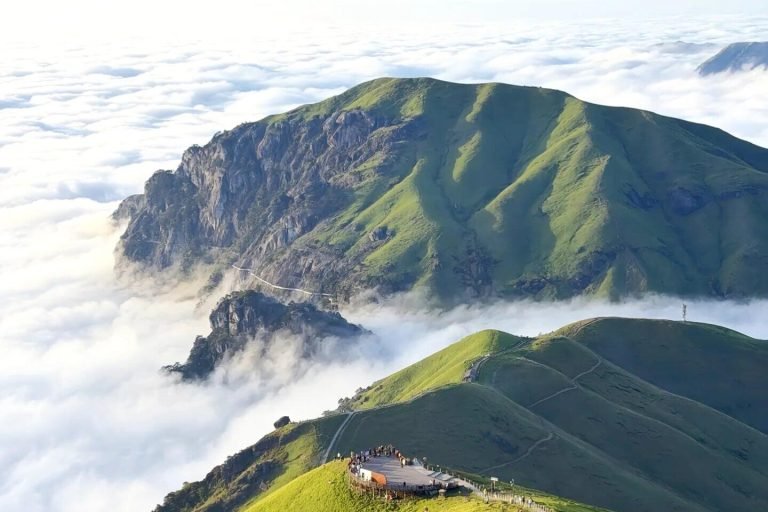
The alarm is 05:45. The private vehicle departs the hotel at 06:15. The Bailong Elevator (百龙天梯) — 335 metres of glass-and-steel elevator shaft built directly into a sandstone cliff face, carrying 4,000 people per day to the Yuanjiajie plateau and holding the Guinness World Record for world’s tallest outdoor elevator — begins operating at 07:00; a Xiora private itinerary positions your party at the base station at 06:50, among the first passengers of the day. Your guide has been monitoring the weather since the previous evening. On a clear day, the Yuanjiajie plateau offers spectacular views of the pillar field with sharp definition at every distance. On a morning with low cloud — the condition that occurs most reliably in April, May, and after autumn rain in October — the valley below the plateau fills to a specific level while the pillar tops remain in clear air, producing the precise atmospheric effect that James Cameron’s team recorded in 2008 and translated into the floating Hallelujah Mountains of Avatar. The Avatar Hallelujah Mountain itself — the Southern Sky Column (南天一柱), officially renamed in January 2010 — is most directly visible from the No. 1 observation deck of the Yuanjiajie plateau loop trail, a 5-kilometre circuit that your guide walks at a pace calibrated to the changing light rather than a departure schedule. Descent is by the Yuanjiajie cable car — a different route from the Bailong ascent, adding a second perspective on the pillar field at a time when the morning crowd is still queuing at the elevator base station below.
Day 4 (Friday) — Tianzi Mountain and Golden Whip Stream
Tianzi Mountain (天子山), reached by cable car from the Suoxiyu Valley base station, offers the park’s most expansive pillar panorama from its upper platforms — the Shentang Bay overlook (仙境谷) in particular commands a 270-degree view across the full Wulingyuan formation that functions, on a clear morning, as the most comprehensive orientation to the landscape’s true scale available anywhere in the park. Your guide will time the Tianzi Mountain visit for 09:30 — after the Yuanjiajie crowd is dispersed across the plateau but before the Tianzi cable car queue builds — and allocate approximately 2.5 hours at the summit before descending by a different route to the Suoxiyu Valley. The afternoon is reserved for Golden Whip Stream (金鞭溪): a 7.5-kilometre valley walk along a clear mountain stream between pillar walls and through groves of ancient ginkgo and sweet gum, where the macaque population has established a comfortable détente with visitors and the light in the late afternoon turns the sandstone surfaces from grey to deep amber. The walk takes 2.5–3 hours at a pace that allows the guide to explain the geological formation of each visible pillar, the specific flora of the Wulingyuan forest understory, and the Tujia legend of the Golden Whip — a general who turned to stone rather than retreat from the mountain he was defending.
Day 5 (Saturday) — Yangjiajie and the Grand Canyon Glass Bridge
Yangjiajie (杨家界) — the western scenic area of the national park, accessed by a separate cable car from the Yangjiajie base station — receives approximately one-fifth of the visitor volume of Yuanjiajie on a typical Saturday, despite offering formations of comparable dramatic quality. Your guide’s routing logic places your party here on the weekend day when the main areas are at their most crowded, converting a potential crowd-management problem into a private-feeling morning in a landscape of 200-metre pillars with no queue at any viewpoint. The afternoon descends to the Zhangjiajie Grand Canyon for the Glass Bridge — 430 metres of glass-bottomed suspension bridge spanning 300 metres above the canyon floor, opened in 2016 and still the most vertiginous engineering structure in the Hunan landscape — before a private vehicle carries your party north toward Changsha for the overnight.
Day 6 (Sunday) — Changsha: The Cultural Return
Changsha, the Hunan provincial capital 2.5 hours by high-speed rail northeast of Zhangjiajie, rewards a morning before the Singapore return flight with two experiences that contextualise everything seen in the preceding five days. The Hunan Provincial Museum holds the most significant Han Dynasty burial assemblage ever excavated in China: the tomb of Lady Xin Zhui (辛追夫人), a Marquise who died around 163 BCE and was buried in four lacquered coffins inside a mound so perfectly sealed with charcoal and white clay that her body, 2,200 years later, was preserved with her skin still elastic and her joints still flexible — the most intact human body ever recovered from the ancient world. Beside her burial goods — 162 lacquerware pieces, 138 silk textiles, and a painted silk T-shaped funeral banner of astonishing iconographic complexity — the Wulingyuan sandstone pillars, ancient as they are, feel relatively recent. The Yuelu Academy (岳麓书院), founded in 976 CE and operating continuously as a centre of Confucian scholarship for over 1,000 years, sits on the forested slopes of Yuelu Mountain beside the Xiang River — a place where the afternoon light through bamboo and ginkgo carries the specific quality of a landscape that has been read in and thought in for a millennium, and where the walk from the main gate to the inner courtyard is the correct way to end a week that began in the glass towers of Singapore five days ago. Evening flight from Changsha Huanghua International Airport (CSX) to Singapore Changi, arriving late Sunday night or early Monday morning — in time, if the schedule permits, for the same Monday morning that left Singapore on Tuesday feeling very far away.
“Under 5 hours from Singapore Changi, no visa, no jet lag — and at 07:15 on a Thursday morning in April, your private guide is standing at the edge of the Yuanjiajie plateau telling you that the cloud level is exactly right, and that the next 45 minutes will be the reason you came.”
The Mist: Why Zhangjiajie’s Atmosphere Is As Important As Its Geology
The Wulingyuan landscape has a second life that no photograph of clear-day visibility captures. When the temperature differential between the valley floor and the plateau creates the right atmospheric condition — most reliably between March and May, and again in October after autumn rain systems have passed — low cloud fills the valley to a specific level while the pillar tops remain in clear air. The effect, from the Yuanjiajie observation deck at this moment, is of standing above a white sea from which 3,000 stone islands are emerging. The mist moves. It rises in columns along the windward faces of individual pillars. It thins in places, briefly revealing the green forested valley 400 metres below, then closes again. It makes the scale of the formation — which on a clear day is magnificent and comprehensible — something stranger and less categorical: a landscape that is doing something to the light rather than simply occupying space in it.
For Singapore travelers, whose daily visual environment is one of the most consistently horizontal and geometrically organised urban landscapes on earth, the encounter with this scale and this atmospheric quality produces a specific category of disorientation that is, once absorbed, enormously restorative. The city-state’s extraordinary efficiency — the MRT timetable, the Changi Terminal transit time, the Gardens by the Bay water-feature schedule — has no equivalent here. The mist does not follow a schedule. The pillar does not begin performing at a designated time. The guide’s job is to be present when the conditions produce the phenomenon, and to have positioned your party correctly in advance. This is not a service you can book on a travel aggregator. It is the product of experience, local knowledge, and the kind of professional attention to atmospheric conditions that a guide who has walked the Yuanjiajie plateau hundreds of times brings as a matter of professional standard.
Singapore to Zhangjiajie: DIY Trip vs. Xiora Private Tailor-Made Tour
| Feature | DIY Singapore Traveller | Xiora Private Tailor-Made Tour |
|---|---|---|
| Flight Booking | Self-managed; Loong Air direct may sell out; indirect routing navigation complex | Xiora consultant advises on SIN→DYG direct vs Changsha routing based on dates; books ahead of peak-season sellout |
| Visa | 30-day visa-free for Singapore passports — correctly handled by most DIY travelers | Confirmed and briefed before departure; guide briefs on entry card completion and any group-member non-Singapore passport requirements |
| Airport Transfer (DYG) | Taxi queue; Mandarin negotiation; no fixed-price meter at DYG; potential overcharge | Private vehicle meets at arrivals; guide present from landing; zero negotiation required |
| Mist Window Management | Fixed tour schedule; 10:00 Yuanjiajie arrival regardless of weather; mist window typically missed | Guide monitors overnight; adjusts Day 3 departure time to 06:15 or 07:00 based on cloud forecast; mist window captured |
| Payments | Alipay/WeChat Pay foreign-card linking unreliable; cash exchange required for smaller vendors | All local payments handled by guide via WeChat Pay; SGD settled at end of trip at live exchange rate |
| Crowd Routing | Published tourist route; Bailong Elevator queue 45–90 min at peak; all viewpoints at same time as every other visitor | Counter-flow routing: Yangjiajie on Day 5 (Saturday, low crowd); Yuanjiajie at 07:00 before queue builds; Tianzi Mountain timed to Huangshizhai crowd peak |
| Changsha Extension | Self-navigated; Hunan Provincial Museum timed-entry pre-booking complex; Yuelu Academy unmarked in English | Pre-booked Hunan Provincial Museum timed slot; Yuelu Academy with historical specialist; Lady Xin Zhui burial goods fully interpreted |
| Shopping Stops | Tujia souvenir stalls adjacent to every major site; no quality guidance | Zero commission stops; guide advises on genuine Tujia brocade weavers and wild mushroom vendors only if specifically requested |

Practical Intelligence: Singapore to Zhangjiajie in 2026
Currency and Payments
The Singapore Dollar to Chinese Renminbi exchange rate in 2026 runs at approximately 1 SGD to 5.3–5.4 RMB, making Zhangjiajie’s most significant expenses — park entrance (¥248 for a 4-day ticket), Bailong Elevator (¥126 round-trip), Tianmen Mountain cable car (¥259), and Glass Bridge (¥138) — manageable in absolute terms for most Singapore traveler budgets. The practical issue is not exchange rate but payment method: the vast majority of Zhangjiajie’s vendor ecosystem operates on WeChat Pay and Alipay, with cash accepted but increasingly uncommon at smaller establishments. Your Xiora guide manages all local payments via their WeChat Pay account, settling with you in SGD at the trip’s conclusion at the live mid-market rate — eliminating the money-exchange queue at Changi or DYG and the WeChat Pay foreign-card linking process that Singapore travellers frequently find unreliable on their first attempt.
Weather: What to Expect from Singapore’s Climate Baseline
Singapore’s daily temperature range of 25–35°C with near-constant high humidity makes the Zhangjiajie climate — which varies from 0°C to 10°C in winter (December–February), 15°C to 25°C in spring and autumn, and 25°C to 35°C in summer — a significant environmental shift in all but the July–August period. Singapore travelers visiting in the optimal April–May or September–October windows should pack one layer warmer than the daytime temperature forecast suggests: the Yuanjiajie plateau sits at approximately 1,000 metres of altitude, and the early morning departure for the mist window means standing at the cliff edge at 07:00 in air that is 5–8°C cooler than the hotel lobby an hour earlier. A light down jacket that compresses to the size of a water bottle is the single most practical packing item for a Singapore-to-Zhangjiajie April itinerary — smaller than anything Singapore’s year-round warmth normally requires, and worth its own luggage allocation for Day 3 alone.
Connectivity and VPN
China’s Great Firewall blocks Google Maps, WhatsApp, Instagram, and Gmail — services that Singapore travelers rely on as default communication and navigation tools. A VPN must be downloaded and activated before leaving Singapore, as VPN provider websites are themselves blocked inside China. Your Xiora guide maintains a Chinese-network device with Baidu Maps and WeChat for all navigation and communication within China; for contact with family in Singapore, a pre-trip VPN configuration on your own device is the only reliable solution. Singapore-issued SIM cards with data roaming enabled for China are an alternative for WhatsApp access, though at roaming data rates that make a locally purchased Chinese SIM (available at DYG airport) the more economical option for a 6-day visit.
Travel Without the Friction
At Xiora Travel, our expert bilingual guides handle every logistical detail, ensuring a seamless, 100% no-shopping luxury experience. Your time belongs to the journey.
Explore Private Journeys ↗What the Journey From Singapore to the Peaks Actually Changes
There is a particular quality of return that the Zhangjiajie journey produces for Singapore travelers — a quality distinct from the jet-lagged disorientation of a long-haul trip, because there is no jet lag here, and distinct from the culture-shock re-entry of a very foreign destination, because the shared time zone and the visa-free entry and the guide who speaks both Mandarin and English have kept the logistical difficulty within manageable bounds. What changes is the internal scale reference. Singapore, viewed from the window of the China Southern flight as it crosses the Strait of Malacca southbound on the Sunday evening return, looks — as it always has — like a precisely organised gem of a city at the tip of the Malay Peninsula. But the traveler looking at it now has spent five days in a landscape where the smallest visible object was 200 metres tall and the largest was a mountain the shape of nothing they have seen before, and the re-entry into the horizontal efficiency of the Lion City carries a new appreciation — not for what Singapore lacks, but for what the 4-hour-55-minute journey to the mist of Zhangjiajie has given it by contrast.
A Xiora tailor-made Singapore-to-Zhangjiajie itinerary is built on the understanding that this contrast — between the city and the peaks, between the timetable and the mist — is the point of the journey. Every logistical decision, from the first-ascent Bailong Elevator positioning to the Changsha morning that ends it, is designed to protect the conditions under which that contrast can be fully felt. The guide does not make the mist appear. They make sure you are standing in the right place when it does.
Frequently Asked Questions
Do Singapore citizens need a visa to visit Zhangjiajie in 2026?
No. Singapore passport holders benefit from a 30-day visa-free entry arrangement with mainland China, operational since the bilateral agreement signed in November 2023 and confirmed as active through 2026. Singapore citizens may enter China at any international port of entry — including Zhangjiajie Hehua International Airport (DYG) on the Loong Air direct service, or Changsha Huanghua International Airport (CSX) on connecting flights — without a pre-arranged visa, for stays of up to 30 calendar days per visit. Non-Singapore passport holders traveling in a party with Singapore citizens — spouses, children, or traveling companions holding passports from other countries — should check their own national status independently; the visa-free arrangement is passport-specific and does not extend to co-travelers. A Xiora pre-trip briefing confirms the entry requirements for every passport in the party before departure.
What is the best way to get from Singapore to Zhangjiajie in 2026?
The fastest option is the Loong Air direct service from Singapore Changi (SIN) to Zhangjiajie Hehua (DYG), operating three times per week (Tuesday, Thursday, and Saturday) with a flight time of 4 hours 55 minutes and fares from S$381 one-way. The limitation is frequency: the route operates only three days per week and sells out in advance during the peak April–October season. The most flexible option is Singapore to Changsha Huanghua (CSX) — served daily by China Southern, Sichuan Airlines, and Juneyao Air, with a 4–5 hour flight time — followed by a 2–3 hour high-speed rail connection from Changsha to Zhangjiajie West station. Total door-to-door time via Changsha is 7–9 hours, but the Changsha routing offers daily departure options and the opportunity to add a Changsha cultural visit (Hunan Provincial Museum, Yuelu Academy) as a Day 6 addition before the Singapore return flight. For most Xiora clients, the recommendation is to book the Loong Air direct service as the primary option and plan the Changsha routing as the confirmed alternative if direct availability is exhausted for the preferred dates.
Is 6 days enough for a Singapore to Zhangjiajie trip, or should I plan for longer?
Six days is the optimal minimum for a Singapore-departure Zhangjiajie itinerary that covers the primary scenic areas — Tianmen Mountain, Yuanjiajie (Avatar Hallelujah Mountain), Tianzi Mountain, Golden Whip Stream, Yangjiajie, and the Grand Canyon Glass Bridge — without feeling rushed at any of them. The structure of the Xiora 6-day itinerary is designed specifically for Singapore travelers whose departure flexibility aligns with the Loong Air Tuesday/Thursday/Saturday schedule: five full days in the Zhangjiajie region (Days 1–5) plus a Changsha cultural morning on Day 6 before the evening return flight to Singapore. Travelers who wish to extend the Fenghuang Ancient Town (凤凰古城) — a beautifully preserved Ming and Qing Dynasty settlement on the Tuojiang River, approximately 4 hours by private vehicle south of Zhangjiajie — should plan for 8 days minimum. Those combining Zhangjiajie with a broader China itinerary (Beijing–Xi’an, Chengdu, Guilin) should allow 12–14 days total, with the Xiora consultant designing the full routing from Singapore to maximise the available time at each destination.