China Travel Without Chinese is not only possible in 2026; for the right traveler, it can be remarkably seamless, provided the journey is designed around language, logistics, payments, and local access rather than left to chance. From the whispering courtyards of Beijing to the terracotta-red earth of Yunnan, China rewards travelers who can move beyond the obvious, but the country’s enormous scale, Chinese-language interfaces, regional accents, mobile-first services, and limited English outside international hospitality can make independent travel feel more complicated than it needs to be. The solution is not to memorize hundreds of characters before departure. It is to build a journey in which communication is handled intelligently, transportation is coordinated precisely, and your time remains devoted to what you came to experience.
✨ At a Glance
- The Core Reality in 2026: You can travel extensively through China without speaking Mandarin, but outside major international hotels and tourist-facing businesses, English is not consistently available.
- Crucial Advice: Set up mobile payments such as Alipay or WeChat Pay before departure, and keep a backup payment method because China’s everyday transactions are heavily digitized.
- The Xiora Solution: Xiora Travel removes the language and logistical friction through 100% private journeys, bilingual local guides, premium transportation, and a strict no-shopping philosophy.
Can You Really Travel China Without Speaking Chinese?
Yes, but there is an important distinction between being able to visit China and being able to travel through China elegantly.
Major gateway cities such as Beijing, Shanghai, Chengdu, Xi’an, and Guangzhou are accustomed to international visitors. At five-star hotels, luxury restaurants, major airports, and many flagship attractions, you will often find English-speaking staff. Translation applications have also changed the equation dramatically. A phone can photograph a menu, translate signage, interpret a short conversation, and help decode unfamiliar instructions within seconds.
Yet China is not an English-speaking destination. Mandarin, known officially as Standard Chinese, functions as the country’s common standardized language, while numerous regional varieties and other Chinese languages are used across the country. Standard Chinese is therefore useful as the linguistic bridge, but that does not mean the average shopkeeper, taxi driver, village host, or restaurant worker will speak English.
The difference becomes especially noticeable once you leave the polished corridors of international tourism. Imagine arriving at a small station outside Xi’an after sunset, the platform humming with luggage wheels and announcements, every sign rendered in Chinese characters, while the driver waiting outside has little English. Or picture a tiny noodle restaurant in Chengdu where the menu is entirely visual and the owner speaks only Sichuanese-inflected Mandarin. These are not failures of the destination. They are simply moments where local infrastructure was never designed around English-speaking visitors.
For experienced travelers, that can be part of the charm. For a luxury traveler protecting limited holiday time, however, unnecessary friction is rarely the point.
China Travel Without Chinese: What Actually Becomes Difficult?
The challenge is rarely ordering a coffee. The challenge is the accumulation of dozens of small moments.
Transportation
China’s high-speed rail network makes long-distance travel astonishingly efficient, but the experience can still feel unfamiliar if you are navigating it alone. Ticketing, station entrances, security checks, departure boards, platform changes, luggage handling, and last-mile transfers all happen within a highly structured domestic system.
At a major station, the hardest part is often not finding the train. It is understanding exactly where you need to be, when you need to arrive, which queue applies to you, and how to move from the station to your hotel after a long journey.
A private itinerary changes this equation. Instead of solving each transfer independently, the journey can be designed as one continuous sequence: hotel departure, station arrival, luggage assistance, train boarding, destination transfer, and check-in.
Restaurants and Local Dining
Food is where the language barrier can become unexpectedly entertaining—and occasionally inconvenient.
In Shanghai, you may have no difficulty reading an English menu in a sophisticated restaurant. In a neighborhood dumpling shop in Xi’an, the story may be different. You may be confronted with Chinese characters, unfamiliar regional specialties, and questions about spice, preparation, or ingredients that cannot easily be communicated through pointing.
This is one reason a knowledgeable bilingual guide can add far more value than simple translation. The objective is not merely to convert Chinese words into English. It is to explain what is worth ordering, how locals eat it, which ingredients are seasonal, and how a dish belongs to the history of that place.
Payments and Everyday Technology
China’s payment environment is one of the most important practical differences for first-time visitors. Mobile payments through services including Alipay and WeChat Pay are deeply integrated into everyday commerce, while international visitors can also use bank cards and cash in appropriate situations. China’s official government travel guidance notes that foreign visitors can link international cards, including Visa and Mastercard, to Alipay and WeChat Pay. China’s official payment guidance for overseas visitors explains the available options and setup considerations.
That means the smartest preparation is not carrying an envelope of cash for every imaginable expense. It is preparing your digital payment ecosystem before you arrive and retaining a backup method for the situations where technology, connectivity, or a merchant’s system behaves differently than expected.

“The luxury of traveling in China is not never encountering another language; it is never allowing the language barrier to interrupt the experience.”
The Luxury Solution: Private Travel Instead of Constant Translation
For travelers accustomed to premium service, the most elegant approach is not trying to eliminate every cultural difference. It is building enough support around the journey that those differences remain fascinating rather than exhausting.
A genuinely private China tour means the guide is not simply translating a scripted speech. The guide becomes a cultural bridge, logistical problem-solver, restaurant interpreter, and real-time navigator.
Consider a morning at the Terracotta Army in Xi’an. Rather than following a large group at a fixed pace, your guide can explain the archaeological significance of Pit 1, answer questions as they arise, adjust the rhythm for photography, and then coordinate the journey onward. After several hours of history, you can return to a private vehicle rather than spending another hour figuring out public transport, negotiating a pickup point, or explaining a hotel address to a driver.
This matters even more when an itinerary combines destinations such as Beijing, Xi’an, Chengdu, Zhangjiajie, Shanghai, and Yunnan. China is geographically enormous. Every additional destination introduces another transfer, another station, another hotel, another driver, another restaurant, and another set of small decisions.
The point of private travel is therefore not simply privacy. It is continuity.
| Feature | Standard Option | Xiora Luxury Standard |
|---|---|---|
| Example | Fixed group itinerary with shared transport and limited flexibility | 100% private itinerary with bilingual local support and flexible pacing |
| Language | Traveler manages most day-to-day communication | Dedicated bilingual guide bridges local and English-speaking environments |
| Transportation | Shared transfers or self-arranged connections | Private vehicle and coordinated domestic logistics |
| Shopping | May include commercial stops depending on operator | Strict no-shopping philosophy |
| Pace | Predetermined schedule | Designed around your preferred rhythm, interests, and comfort |
How to Prepare for China If You Speak No Mandarin
The good news is that preparation can be surprisingly simple. You do not need to become fluent. You need a reliable travel system.
Download the Right Tools Before You Fly
Have your translation application, maps, booking confirmations, hotel addresses, important contact numbers, and payment applications available before leaving home. Do not assume you will be able to install or configure everything comfortably after landing.
For hotels outside major international chains, save the Chinese name and Chinese address. A screenshot can be more useful than a beautifully formatted English confirmation page when communicating with a local driver.
Learn a Few Useful Chinese Words
You do not need conversational Mandarin, but a handful of expressions can transform everyday encounters. “Ni hao” means hello, “xiexie” means thank you, and “duibuqi” means sorry. Numbers are useful for prices, while knowing how to say “bu la” for “not spicy” can be particularly valuable for travelers exploring Sichuan and Hunan cuisine.
The goal is not linguistic perfection. It is courtesy. A sincere attempt to use even a few Chinese words often creates an immediate human connection.
Keep Important Information Offline
China is a digitally sophisticated country, but sophisticated does not mean infallible. Keep screenshots of hotel confirmations, railway details, passport information, emergency contacts, and your itinerary accessible offline.
For a luxury journey, your concierge or private guide should also have the same core information. Redundancy is not glamorous, but it is one of the foundations of seamless travel.
Where Speaking English Works Best—and Where It Does Not
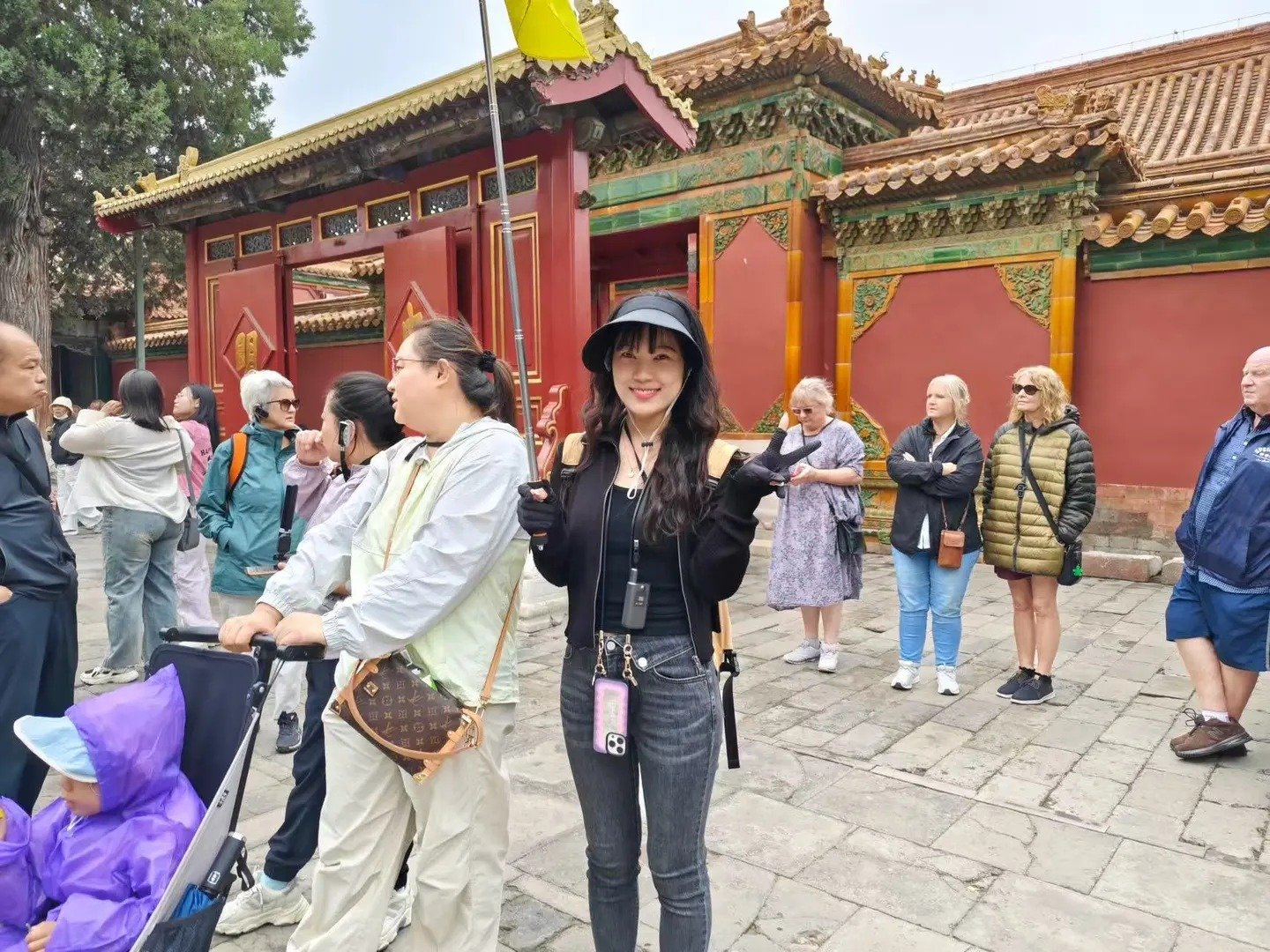
English is most dependable where international tourism is concentrated. In luxury hotels, major airports, international restaurants, premium retail environments, and established tourist attractions, you will generally find more English-language infrastructure.
Reliability drops as you move into local neighborhoods, smaller towns, countryside attractions, independent restaurants, traditional markets, and less-visited regions. This is especially relevant to travelers who want authentic experiences, because the most memorable places are often precisely those with the least English support.
This is one of the paradoxes of traveling in China. The less touristy your experience becomes, the more valuable a trusted local intermediary can be.
Why Private Guides Matter More Outside Beijing and Shanghai
Beijing and Shanghai are relatively straightforward entry points for international travelers. The deeper you travel, however, the greater the value of local expertise.
In Xi’an, a local guide can explain why the city’s history extends far beyond the Terracotta Army and connect the ancient capital to the Silk Road. In Chengdu, the difference between seeing a panda and understanding Sichuan culture lies in the texture around the headline attraction: teahouses, mahjong tables, local cuisine, and the rhythm of neighborhood life.
In Yunnan, where landscapes stretch from the lakeside atmosphere of Dali toward the mountain valleys around Lijiang and beyond, the experience becomes less about checking landmarks and more about understanding geography, minority cultures, altitude, roads, weather, and the changing pace of the journey.
A bilingual guide can explain what you are seeing while simultaneously managing what you cannot see: timing, communication, reservations, traffic, entry procedures, and the small local details that never appear in an English-language itinerary.
Travel Without the Friction
At Xiora Travel, our expert bilingual guides handle every logistical detail, ensuring a seamless, 100% no-shopping luxury experience. Your time belongs to the journey.
Explore Private Journeys ↗What “Luxury” Really Means When You Do Not Speak Chinese
Luxury in China is not necessarily another marble lobby or another expensive room. Those things have their place, but true luxury is the removal of unnecessary decisions.
It is stepping out of a five-star hotel and already knowing who is collecting you. It is arriving at a railway station without wondering which sign matters. It is sitting down at a local restaurant and understanding what is on the table. It is entering an ancient site with the context already explained. It is being able to change the pace of the afternoon because you are tired, fascinated, or simply want another hour in the old quarter.
Most importantly, it is being free to be a traveler rather than becoming a part-time logistics manager.
Xiora Travel describes its journeys as 100% private and no-shopping, with bespoke itineraries, premium transportation, bilingual guides, and support designed around the individual traveler rather than a fixed group schedule. Its tailor-made China travel model is built specifically around dates, pacing, hotels, destinations, and interests, with domestic logistics coordinated as part of the journey. Explore Xiora’s tailor-made China tours.
The company’s China tour collection also spans destinations including Xi’an, Beijing, Chengdu, Yunnan, and Zhangjiajie, allowing travelers to build multi-city journeys without having to solve every connection independently. See Xiora’s private China tour packages.
So, Should You Travel to China Without Speaking Chinese?
Absolutely—but travel intelligently.
If you are highly independent, comfortable with translation technology, patient with unfamiliar systems, and willing to spend time preparing your digital tools, China can be an extraordinary self-guided adventure.
If your priority is a deeper itinerary, premium accommodation, private transportation, meaningful local experiences, and the freedom to move through China without constantly negotiating language and logistics, professional private travel offers a different proposition.
You are not paying someone to translate every word. You are buying back the hours that would otherwise disappear into uncertainty.
And that distinction becomes particularly important in a country as immense as China. A ten-day itinerary can pass quickly. There is little luxury in spending the best part of those ten days figuring out how to communicate with a driver, deciphering a ticketing interface, searching for the correct restaurant entrance, or worrying about whether the next transfer has actually been confirmed.
The most memorable moments are rarely the ones where everything went smoothly because technology worked perfectly. They are the moments when the system disappeared completely: the first glimpse of the Great Wall rising through the morning haze, the scent of cumin and charcoal drifting through a Xi’an alley, the quiet of a Yunnan courtyard after rain, or the moment a guide translates a local story that suddenly makes a centuries-old building feel alive.
That is the real answer to China Travel Without Chinese. You do not need to speak the language to feel close to the country. You need the right bridge between you and the place.
Frequently Asked Questions
Can I visit China if I do not speak any Chinese?
Yes. International hotels, major airports, tourist attractions, translation technology, and increasingly visitor-friendly digital payment services make China accessible to English-speaking travelers. The main difficulty is that English becomes much less dependable outside international tourism infrastructure, particularly in local restaurants, smaller towns, rural areas, and everyday transportation.
What should I do if I cannot communicate with people in China?
Use a translation app, keep hotel and destination information saved in Chinese characters, and use screenshots for important addresses and confirmations. For a more comfortable premium journey, a bilingual private guide can handle conversations, transportation, restaurants, reservations, and unexpected logistical issues for you.
Is China a good destination for luxury travelers who do not speak Mandarin?
Yes. In fact, private travel can make China particularly compelling for luxury travelers because the country’s sophisticated hotels, remarkable high-speed rail network, exceptional cuisine, historic sites, and diverse landscapes can be combined into a highly personalized itinerary. The key is choosing an operator that handles the language and logistical layer while keeping the journey private, flexible, and free from unwanted shopping stops.