The best time to visit Zhangjiajie is a question that rewards precision over generality — because the answer depends entirely on the kind of experience you are seeking, and because the difference between the right week and the wrong one, in a destination as meteorologically dramatic and logistically intense as this, is the difference between a transcendent encounter and a genuinely frustrating ordeal. Zhangjiajie’s quartz-sandstone pillars, rising in their thousands from the mist-filled valleys of northwestern Hunan Province, inspired the floating Hallelujah Mountains of James Cameron’s Avatar. They exist in reality, in all their vertiginous, otherworldly grandeur — and they deserve to be experienced in conditions that do justice to their scale and strangeness.
This guide provides the most precise, current, and practically useful seasonal intelligence available for 2026 — written specifically for the luxury private traveller who has made a long-haul commitment to one of the world’s most extraordinary natural landscapes and wishes to arrive on exactly the right day.

Understanding Zhangjiajie’s Climate: What Makes This Destination Unique
Before diving into the seasonal breakdown, the most important thing a luxury traveller can understand about Zhangjiajie’s weather is its intrinsic unpredictability — and why that unpredictability is not a flaw in the destination but one of its defining characteristics. Zhangjiajie has a subtropical monsoon climate with four distinct seasons, and rainfall is fairly well distributed throughout the year. When rain and fog appear, the quartz-sandstone pillars, forest, and streams are all covered with mist, forming a magical wonderland.
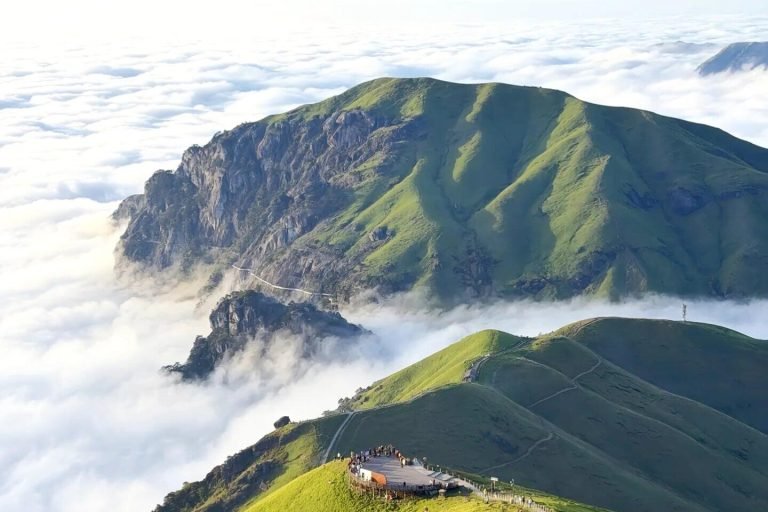
This is the essential truth of Zhangjiajie that separates the experienced traveller from the disappointed one: the mist is not bad weather. It is the weather that makes this landscape look most like Pandora. The thirty to ninety minutes after a summer downpour, when fog rises from the valleys in horizontal layers and the lower portions of the pillars dissolve into white cloud while their tops remain visible, is the moment when Zhangjiajie most completely fulfils its visual promise. A clear blue-sky day offers panoramic definition. A mist-shrouded morning offers something closer to myth. Both are extraordinary. The traveller who arrives expecting only sunshine and leaves disappointed by fog has misunderstood the theatre they have entered.
With that foundational understanding in place, here is how each season performs — honestly, specifically, and for the luxury private traveller specifically.
Spring (March to May): The Recommended Window for Most Luxury Travellers
Spring is, by the broadest consensus and for the most coherent set of reasons, the optimal season for a luxury private Zhangjiajie itinerary — but within spring, a specific two-week window outperforms everything else, and identifying it precisely is the difference between a very good visit and an exceptional one.
Mid-April to Late April: The Single Finest Window of the Year
The two weeks bracketing the middle of April represent Zhangjiajie’s most consistent convergence of favourable weather, manageable visitor numbers, and peak natural beauty. In this period, temperatures hover between a lovely 15 to 20°C (59 to 68°F), and the rain, while possible, usually comes as a gentle mist rather than a downpour. The forest is in its freshest, most intensely green state: the broad-leaved trees have leafed out fully, wildflowers appear along the Golden Whip Stream trail, and the waterfalls that thread through the park’s gorges are running at their most photogenic volume after winter’s snowmelt. Visitor numbers — still elevated compared to the winter lows — have not yet reached the May Day surge, and a private tour with expert guide and priority access arrangements produces the conditions of relative solitude that transform a famous landscape into a personal one.
Early March: The Moody, Atmospheric Alternative
March can feel a bit chilly and foggy until April rolls around , and for travellers who are specifically drawn to the ethereal, ink-wash quality of the landscape — the version of Zhangjiajie that looks most like a classical Chinese painting, all veiled peaks and ghost-grey atmosphere — this is actually the correct time to come. The park is quiet, hotel rates are at their lowest of the warmer months, and the morning mist effects are at their most sustained and dramatic. Warm layering, waterproof boots, and an appreciation of the sublime are the only requirements.
May Day Holiday (May 1–5): Avoid Without Exception
During the Labor Day Golden Week from May 1 to 5, the park receives 400 to 700 percent of its normal visitor capacity. Every viewpoint becomes standing-room-only. The Bailong Elevator — the world’s tallest outdoor elevator at 326 metres, running three double-deck cars simultaneously — normally carries 18,000 people daily. Labor Day demand exceeds 50,000, and regular wait times of 10 minutes balloon to four hours or more. No private tour, however expertly designed, can overcome the physical reality of this level of saturation. The May Day period is the single most important date to avoid on the entire Chinese calendar for Zhangjiajie travel.
Summer (June to August): The Cloud Sea Window
Summer is Zhangjiajie’s most complex season for the luxury traveller — genuinely rewarding for those who understand its specific offerings, genuinely punishing for those who do not. The honest picture requires acknowledging both sides of the ledger.
What Summer Does Brilliantly
Summer delivers the most dramatic post-rain cloud sea effects of any season. Summer rain follows a reliable pattern: afternoon downpours lasting one to two hours, then clearing. The 30 to 90 minutes after rain stops delivers the most dramatic cloud seas — fog rises from the valleys in horizontal layers — and this is when Zhangjiajie looks most like Avatar’s Pandora. If your primary motivation for visiting Zhangjiajie is to witness the landscape that inspired the film in its most cinematically faithful form, summer rain events are your best opportunity, and they occur with high frequency.
There is also an important thermal fact that surprises most visitors: Zhangjiajie city hits 35°C regularly in July and August, but climb to Yuanjiajie or Tianzi Mountain and you need a light jacket by evening — the elevation difference creates a 10°C or more temperature gap. The high park areas are, even at the height of summer, considerably more comfortable than the city base, and the dense forest canopy provides natural shade that significantly moderates the experienced temperature on trail.
What Summer Does Badly
July and August are China’s school holiday months, and the domestic tourism surge they produce is the heaviest Zhangjiajie experiences all year. The surge in tourists from June to August stems from students beginning their vacations: in early June, high school seniors complete their college entrance exams and start their long-term vacation; then from July, the full domestic family travel season begins in earnest. For a luxury private traveller, this means that even with priority access arrangements, VIP lanes, and an expert guide managing the logistics, the sheer physical density of the peak summer crowd creates conditions that a Zhangjiajie experience designed for depth and contemplation cannot fully overcome.
June — before the school holiday begins in earnest — occupies a genuinely interesting middle position: May and June are the best months to visit if you’re looking for fewer crowds and lower temperatures , though June brings Zhangjiajie’s highest monthly rainfall. For the cloud sea enthusiast willing to accept wet-weather logistics, early June is a genuine sweet spot. For most luxury travellers, however, the spring and autumn windows are more reliably satisfying.
“The mist that rises from Zhangjiajie’s valleys after summer rain is not a meteorological inconvenience — it is the visual language in which this landscape tells its most extraordinary story. The best time to visit is the time that matches the version of the story you want to hear.”
Autumn (September to November): The Connoisseur’s Season
Autumn is arguably the most sophisticated season for the luxury Zhangjiajie visitor — and the one that rewards the most precise timing within the broader window. The best months to visit Zhangjiajie are April and May in spring and September and October in autumn, when the weather is pleasant, the scenery is beautiful, and the crowds are relatively smaller. Within autumn, however, the internal variation is significant and worth understanding in detail.
September: The Crowd-Drop Window
September still carries summer humidity, but Chinese students return to school and crowds drop 40 percent after August. Morning fog is common — overnight humidity above 90 percent creates cloud seas at sunrise. The result is a month that combines the dramatic atmospheric effects of the summer season with significantly reduced visitor pressure. For the early-rising luxury traveller willing to be at the Yuanjiajie viewpoint at 6am for the sunrise cloud sea before the first tour groups arrive — a logistical arrangement that a Xiora private itinerary builds in as standard — September mornings deliver some of the year’s most memorable experiences.
Mid-October to Mid-November: The Foliage Peak
The weeks bracketing the end of October represent one of Zhangjiajie’s most visually spectacular periods. From late October to mid-November, you will be welcomed by vibrant foliage. This is the prime season for hiking, biking, and climbing amid crisp, fresh air. The combination of the sandstone pillar landscape — already among the most visually arresting on earth — with the autumn colour of the broadleaf forest canopy creates a palette of extraordinary richness: the grey rock, the rust and gold of turning leaves, the deep evergreen of the pine stands, and above it all, the clarity of the post-monsoon sky that makes the October horizon in Hunan Province feel impossibly crisp.
In October and November, with colourful autumn leaves, Zhangjiajie becomes a dynamic landscape painting. Tianzi Mountain — where the characteristic flat-topped pillars create a view unlike anything else in the park — is at its most extraordinary in this period, the coloured foliage framing the ancient geology in a way that the summer’s uniform green cannot approach.
National Day Golden Week (October 1–7): The Non-Negotiable Exclusion
National Day sees over 700 million Chinese travel in one week. One 2025 visitor at Zhangjiajie reported: “Waited 3 hours for the bus inside the park. Another 90 minutes for the elevator. Saw more people than mountains.” The National Day Golden Week is the only period in the autumn window that must be avoided absolutely, and its exclusion is as non-negotiable as the May Day holiday in spring. The private luxury traveller arriving in the second week of October, after the Golden Week crowds have dispersed, enters a Zhangjiajie that is almost unrecognisable in its calm compared to the week prior.

Winter (December to February): The Secret Season
Winter is Zhangjiajie’s best-kept secret — and among the most compelling options for the luxury private traveller whose priority is solitude, drama, and a genuinely unusual visual encounter with a landscape that most visitors never see in this form.
Between late December and February, prepare yourself for the winter version of the Avatar Mountains, covered by ice and snow, without lining up in queues. When snow appears, the scenery in the mountains, parks, and canyon shows a different kind of beauty — instead of dressing in green, the hills dress up in white and brown. The transformation is genuinely radical: the same pillars that read as lush and tropical in summer become silent, silver-white monoliths in the January snow, their frost-covered surfaces catching the low winter light in a way that is, in its own register, as visually arresting as anything the warmer seasons produce.
Hotel rates in December can drop by as much as 60 percent compared to early October. The park’s trails, viewpoints, and cable cars operate normally through most of the winter — almost all the cable cars and elevators run regularly during the winter period — though travellers should be prepared for the possibility that extreme icy conditions may occasionally close specific routes, and non-slip footwear is non-negotiable on the mountain paths.
The one winter period to avoid is Chinese New Year. Chinese New Year 2026 falls on February 16 to 23, and the window from February 9 through March 1 should be avoided entirely. Even winter’s quiet season becomes chaos during this period, train tickets sell out months ahead, and hotel rates have been observed jumping from ¥300 to ¥900 per night.
The Definitive 2026 Crowd Calendar: Dates to Protect and Dates to Avoid
Priority travel windows for luxury private visitors: Mid-April to late April (finest overall combination); mid-October to mid-November (peak foliage); early September (cloud seas with reduced crowds); January to early February (winter solitude and snow).
Dates to avoid unconditionally: May 1–5 (Labor Day Golden Week); October 1–7 (National Day Golden Week); February 9 – March 1 (Chinese New Year and its extended aftermath).
Dates requiring careful management but navigable with private expert guidance: Late April approaching May Day; late September approaching National Day; July and August (peak summer with dramatic cloud seas but maximum domestic crowds).
What the Best Possible Zhangjiajie Day Looks Like
The difference between a good Zhangjiajie day and an exceptional one is, above all else, a question of timing within the day — and this is where a specialist private guide earns their distinction most visibly. The best strategy is to arrive at Avatar Hallelujah Mountain at Yuanjiajie during sunrise between 6 and 7am, then complete the Golden Whip Stream hike from 8 to 11am before the crowds arrive. Save Tianzi Mountain for the afternoon after tour groups leave. Avoid the Bailong Elevator between 10am and 2pm when queues peak.
A Xiora-designed Zhangjiajie day is built around this intelligence as a matter of first principle. The 6am arrival at Yuanjiajie — before the general admission gates have opened for the day’s first buses — is not a hardship for the luxury traveller. It is the entire point. The Hallelujah Mountain viewpoint in the dawn light, with the cloud sea still filling the valley floor and the pillars emerging from it one by one as the sun gains altitude, is an experience of such extraordinary visual power that travellers who have seen it consistently describe it as one of the defining moments of their China journey. The crowd that arrives two hours later encounters a beautiful landscape. The private traveller who arrived at sunrise encountered a revelation.
The Wulingyuan Scenic and Historic Interest Area — the UNESCO World Heritage Site that encompasses Zhangjiajie National Forest Park — covers an enormous area, and a Xiora specialist itinerary distributes the key experiences across multiple days to prevent the exhaustion and superficiality that a single-day rush invariably produces. Three to four days is the recommended minimum for a genuine engagement with the landscape: enough time for the National Forest Park’s pillar formations, the Tianmen Mountain cable car and Heaven’s Gate experience, the Golden Whip Stream trail, the Grand Canyon Glass Bridge, and the Baofeng Lake boat journey — with pace left for the contemplative moments that separate a luxury private itinerary from a tick-box sightseeing circuit.
“Stand at the Hallelujah Mountain viewpoint at sunrise, before the first buses arrive, and you will understand why James Cameron spent a decade trying to recreate what you are seeing with your own eyes — and why no digital effect has ever quite succeeded.”
Zhangjiajie’s Principal Attractions: When Each Is at Its Best
Yuanjiajie and the Hallelujah Mountain (Avatar Mountains)
The iconic pillar formations of Yuanjiajie — including the Qiankun Column, officially renamed the “Avatar Hallelujah Mountain” in 2010 — are spectacular in every season but reach their most cinematically faithful appearance during and immediately after summer rain events, when the cloud sea fills the valley and the pillars appear to float. For clear panoramic views and the most comfortable hiking conditions, mid-April and mid-October are optimal. The dawn visit in any season produces an experience incomparably superior to the midday arrival that most group tours deliver.
Tianmen Mountain and the World’s Longest Cable Car
Tianmen Mountain — the highest peak in Zhangjiajie at 1,518 metres, accessible via the world’s longest cable car from the city centre — is at its most dramatic in October, when the autumn foliage on the lower slopes and the clarity of the sky combine to create views of extraordinary depth and colour. The glass skywalk along the cliff face and the natural arch of Tianmen Cave (Heaven’s Gate) are accessible year-round, though winter ice can affect specific sections. The mountain’s elevation means it is 8–10°C cooler than the city in summer, making it the most pleasant high-altitude escape during the July-August heat.
Golden Whip Stream
This 7.5-kilometre forest trail, following a crystal stream through a corridor of sandstone cliffs with monkeys in the canopy overhead, is at its most beautiful in spring (when the forest is at its freshest and the stream at its most vigorous) and in early autumn. It is the experience in Zhangjiajie that most rewards a slow, unhurried pace — and therefore benefits most from the private itinerary format that allows a traveller to stop, sit by the water, and listen, rather than keeping pace with a group.
Grand Canyon Glass Bridge
The Grand Canyon Glass Bridge — 430 metres long, suspended above a gorge at 300 metres altitude — is dramatic in any weather and any season, but the sight of mist rolling through the canyon below the glass floor is a specifically autumn and spring experience that transforms what is already an extraordinary architectural feat into something genuinely surreal. Advance booking through a private specialist is essential, as daily visitor numbers are strictly controlled.
Baofeng Lake
This mirror-still lake, enclosed by sheer cliffs and accessible only by boat, is at its most beautiful in spring (when the surrounding vegetation is at its most intensely green and the reflections are sharpest) and in autumn (when the foliage introduces warm colour to the cliff walls). A private boat on the lake at dusk, with the evening light softening the limestone faces above, is one of the most quietly extraordinary experiences Zhangjiajie offers — and one that a private itinerary can arrange at the precise time of day that maximises the light.
Travel Without the Friction
At Xiora Travel, our expert bilingual guides handle every logistical detail, ensuring a seamless, 100% no-shopping luxury experience. Your time belongs to the journey.
Explore Private Journeys ↗Pairing Zhangjiajie with a Broader Luxury China Itinerary
Zhangjiajie sits in Hunan Province in south-central China, and its geographic position makes it an elegant component of several broader private luxury itinerary architectures. The most natural pairing for most international luxury travellers is with Guilin and Yangshuo — both destinations in the karst landscape tradition, and both reachable by high-speed rail or domestic flight, creating a southern China journey of extraordinary natural consistency: the Avatar pillars of Zhangjiajie, the tower karst and Li River of Guilin, the rice terraces of Longji. Together, they constitute one of the great landscape journeys available anywhere in the world.
For travellers approaching Zhangjiajie as part of a longer China circuit, the logical sequence combines it with Chengdu (giant pandas, Sichuan cuisine, the Buddhist cliff sculptures at Leshan) and then the Yangtze Delta cities of Suzhou and Hangzhou. A Xiora-designed private itinerary of twelve to fourteen days covering these southern and central China regions is a journey of remarkable coherence — natural grandeur and classical civilisation in a dialogue that spans two thousand kilometres and five thousand years.
US passport holders using the 240-hour transit framework can design a clean and deeply satisfying itinerary around Zhangjiajie: entering via Beijing or Shanghai, moving south to Zhangjiajie and Guilin, and departing via Hong Kong or another regional hub. For UK, Australian, and European passport holders operating on the 30-day visa-free programme, Zhangjiajie as one of three or four regional stops across a longer private China journey is the natural design. Either way, begin the conversation with a Xiora Travel specialist early enough to secure the specific seasonal window and priority access arrangements that this landscape genuinely demands.
Frequently Asked Questions
What is the absolute best month to visit Zhangjiajie in 2026?
For the combination of comfortable weather, manageable crowd levels, and peak natural beauty, mid-April is the single optimal month for most luxury private travellers. The forest is at its freshest, temperatures are ideal for hiking between 15 and 20°C, the rain tends toward gentle mist rather than heavy downpours, and the National Forest Park has not yet entered the summer school-holiday surge. The one caveat is the Labor Day Golden Week on May 1–5, which means that an April visit should end by April 28 at the latest, or be planned for the period well after May 5. For travellers whose schedules do not permit April, mid-October to mid-November is a close equal — with the specific advantage of the autumn foliage colour that April cannot offer.
Is fog and mist a problem at Zhangjiajie, or should I embrace it?
Fog and mist at Zhangjiajie are not problems — they are features, and understanding this is the single most important perspective shift a traveller can make before visiting. The mist that frequently fills the valleys between the sandstone pillars is precisely the atmospheric condition that makes this landscape look like Pandora; it was this quality, observed by James Cameron’s art team during location scouting, that directly inspired the floating Hallelujah Mountains. A clear day offers panoramic definition and photographic reach. A mist day offers atmosphere, intimacy, and the eerie sense that the geological formations are genuinely suspended in cloud. Both are magnificent. Neither is a disappointment. The traveller who builds flexibility into their Zhangjiajie schedule — spending three or four days rather than one — experiences both, and leaves with a richer and more complete picture of an extraordinary place.
How many days should I plan to spend in Zhangjiajie on a luxury private itinerary?
Three to four days is the minimum for a genuinely satisfying luxury private engagement with Zhangjiajie’s principal attractions. One day is sufficient only for the most compressed itineraries, and it reliably produces the experience of having seen the landscape without having encountered it. Four full days allows for the National Forest Park across two dedicated visits (morning and afternoon light tell very different stories), Tianmen Mountain on its own full day (the cable car ascent, the cave, the glass skywalk, and the evening descent), the Golden Whip Stream at a contemplative pace, the Grand Canyon Glass Bridge, and a private Baofeng Lake boat at dusk — with time remaining for the Tujia minority cultural experiences of Fenghuang Ancient Town, which Xiora frequently incorporates as a day-trip from Zhangjiajie for clients with a cultural depth interest to complement the natural landscape focus.